INTRODUCTION
Why this matters
Your internal environment changes continually. Meals, activity, sleep, ambient temperature, and ordinary metabolism all create disturbances. Homeostasis is the coordinated, dynamic regulation that keeps important internal conditions within workable ranges. It does not mean that every measurement is fixed at one perfect number.
Learning objectives
- Define homeostasis and explain why it is dynamic rather than perfectly static.
- Identify a regulated variable, sensor, integrating center, and effector.
- Trace the sequence of a feedback-control loop.
- Explain negative feedback and contrast it with positive feedback.
- Apply the framework to temperature and blood-glucose examples.
- Distinguish physiology education from personal diagnosis or treatment.
Before you begin
No prior clinical training is required. It helps to know that cells, tissues, organs and organ systems work together.
Key vocabulary
- Homeostasis
- Dynamic regulation that keeps internal conditions within workable ranges.
- Regulated variable
- A condition the body monitors and influences.
- Sensor
- A receptor that detects a relevant change.
- Integrating center
- The part of a control system that compares information and coordinates a response.
- Effector
- A tissue or organ that carries out the response.
- Negative feedback
- A response that opposes a deviation.
- Positive feedback
- A response that amplifies a process toward a defined endpoint.
Choose your explanation level
All levels describe the same approved concept. Your choice is not saved.
Foundation
Remember: detect → coordinate → respond → reassess. The body notices a change, organizes a response, acts, and checks again.
Healthcare Learner
Connect the steps to a receptor or sensor, integrating center, effector and regulated variable. New information returns after the response.
Medical Student Extension
Distinguish a conceptual set point from a physiological range. Multiple nested control systems may influence an observed value.
The feedback-loop framework
A regulated variable is a condition that a control system monitors. A sensor detects a relevant change. An integrating or control center interprets that information and coordinates a response. An effector carries out the response. The response then changes the regulated variable and supplies new information to the loop.
Negative feedback
Negative feedback acts in a direction that reduces a deviation. Temperature regulation is a useful general example: sensors detect change, coordinating centers integrate the information, and effectors alter heat production or heat loss. The word “negative” describes the direction of the loop; it does not mean that the response is harmful.
Positive feedback
Positive feedback amplifies a process until a defined endpoint interrupts it. It should not be described as the ordinary mechanism that keeps every internal variable stable. “Positive” also does not mean beneficial; it describes amplification.
General examples
Temperature
When body temperature rises, sweating can increase evaporative heat loss and oppose the deviation.
Blood glucose
Blood-glucose regulation illustrates coordinated sensing, signaling and effector responses. This does not set an individual target or diagnose a person.
Clinical connection
Loss or overload of regulatory mechanisms can contribute to dysfunction. That general principle helps explain physiology, but it cannot diagnose an individual or determine treatment from a symptom or isolated measurement.
Common misconceptions
- Homeostasis does not mean no change.
- Negative feedback does not mean something bad is happening.
- Positive feedback is not always harmful, but it is amplifying rather than stabilizing.
- One organ does not control all homeostasis.
- A single unusual measurement does not, by itself, prove failure of the entire system.
Summary
Homeostasis is dynamic regulation. A feedback loop links a regulated variable, sensor, integrating center, effector, and response. Negative feedback commonly reduces deviation; positive feedback amplifies a process toward an endpoint. This framework is educational and does not replace individualized clinical evaluation.
SEE & DRAW
Trace the feedback loop
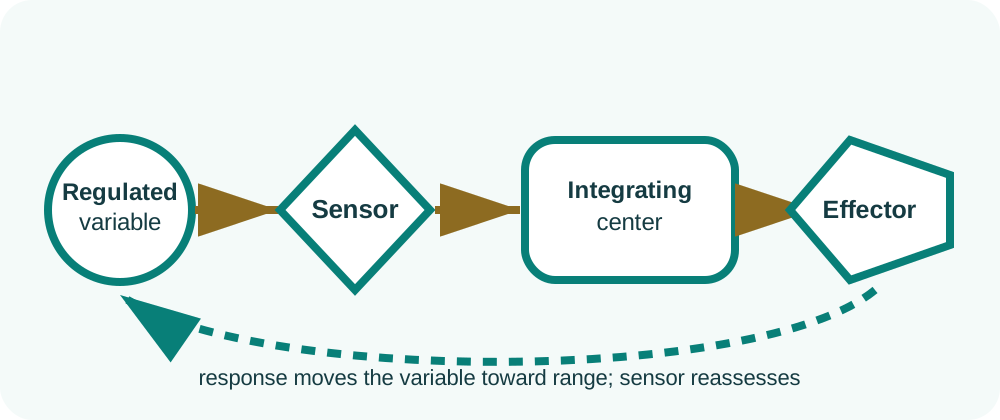
Read the diagram’s long description
A clockwise loop begins with a change in a regulated variable. A sensor detects it and sends information to an integrating center. The integrating center coordinates an effector response. The response influences the variable and reassessment supplies new information.
PRACTICE
Check your understanding
Submitting reveals a rationale for every option. Nothing is saved or transmitted.
FLASHCARDS
Quick review
No progress or streak is recorded.
What is homeostasis?
Dynamic regulation of internal conditions within workable ranges.
What does a sensor do in a feedback loop?
It detects a relevant change in a regulated variable.
What direction does negative feedback act?
It acts to reduce a deviation from a regulated condition.
Sources and review
- OpenStax, Anatomy and Physiology 2e, §1.5 Homeostasis. Citation and original paraphrase only.
- NCBI Bookshelf / StatPearls, Physiology, Homeostasis. Reference and original paraphrase only.
Review disclosure
This lesson was reviewed through the Doctors of Hope Academy internal accuracy and editorial process using authoritative sources, AI-assisted review and Founder Medical-Education review. It has not been represented as independent clinical, legal, accreditation or peer review.
Curriculum currency
Version 1.0.0 · Current as of August 31, 2026. Sources last checked August 31, 2026. Review is due within 12 months or earlier when triggered. Automatic medical rewriting is disabled.
How curriculum currency works · Report a possible correction
More ways to learn
Listen
LISTEN VERSION IN PRODUCTION
Watch
FOUNDER-LED VIDEO LESSON PLANNED
Printable PDF
A public PDF is not available. Use the print button for a clean browser printout.